A Single Network
If A wants to talk to B, well, they're on the same LAN (Local Area Network), so A addresses the packet directly to B:
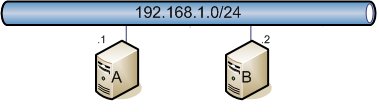
So "A" can send a packet to "B" like this:
| Source IP | 192.168.1.1 | (A) |
|---|---|---|
| Destination IP | 192.168.1.2 | (B) |
| Data | Hello B! This is the Data | |
Unfortunately, it's not as simple as that. The IP address identifies the machines at a software (logical) level, but the physical (MAC) layer isn't the same as the logical (IP) layer.
- The IP layer needs to be able to route from Alaska to Zebediela. It works at a relatively high level.
- The MAC layer only needs to talk to machines on the local network (LAN). It works at a low level.
| Source IP | 192.168.1.1 | (A) |
|---|---|---|
| Source MAC | 01:C0:F2:69:31:21 | (A) |
| Destination IP | 192.168.1.2 | (B) |
| Destination MAC | 03:A0:B3:27:A2:2E | (B) |
| Data | Hello B! This is the Data | |
So how does A find out what B's MAC address is?
Networking Tutorial


